
Azeroth Survivors builds: make each upgrade solve a problem
By azeroth-survivors.online · Reviewed
Choose upgrades around the spell you actually use and the enemy you need to beat. A damage increase helps a single boss; an extra target helps only when another enemy is in range. Use the calculator below with the values on your own cards to compare those trade-offs.
This is a build-planning method and a simple arithmetic tool. The sample values are illustrative, rather than a current class database or a measured ranking.
A practical plan before the first card
- Choose one job for your core spell. Decide whether your immediate problem is a growing pack, a boss that lives too long, or reaching enemies safely. Read the current spell and talent descriptions before following a suggested route.
- Compare the whole before-and-after card. Damage, time between casts and target count interact. A large percentage on a spell you rarely land can be less useful than a smaller improvement on your main attack.
- Keep an escape available. When damage is already adequate, a defensive choice can buy time to reposition. The calculator does not assign a damage value to healing, shields, slows or movement.
- Reassess when the threat changes. Extra targets can solve the pack before a boss, while adding nothing to an isolated boss fight. A useful run plan can change when the next obstacle changes.
For movement and the older class picker, start with the beginner controls guide. Before testing a different browser or build, export a save.
Which card should I take right now?
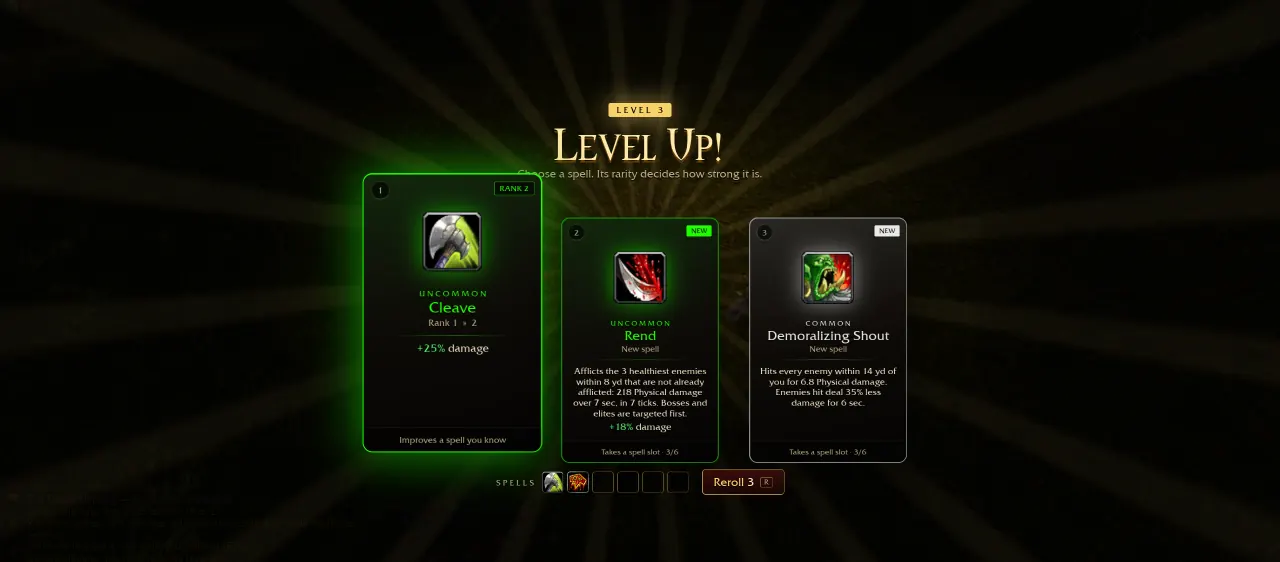
Start with the failure you can see, then inspect the cards actually offered. The checks below use spell behavior and your current tooltips; they do not prescribe a class route or assume a particular patch.
Packs take too long to clear
First check range and coverage: are several enemies within the spell's reach on the same cast? A larger target cap cannot help against enemies outside its range or area. Area size and target cap are different properties, so do not enter an area increase as an extra target in the calculator.
If reachable enemies exceed the current cap, compare an extra-target card with damage and cooldown changes. If the cap already covers every reachable enemy, increasing it adds nothing in this model. Enter the final values from each offered card in the card calculator and keep the reachable-enemy count realistic.
A boss takes too long to kill
For an isolated boss, set reachable enemies to 1. An extra-target-only upgrade cannot raise the model's single-target output. Compare damage per hit and seconds between casts together; a shorter interval can change the result even when the damage number stays the same.
Check whether you can stay in range safely. The formula assumes each cast hits for full damage; it does not account for missed attacks or time spent out of range. If other enemies are present, compare the isolated-boss case separately from the pack rather than treating all damage across the screen as boss damage.
I die before the extra damage can matter
Identify what ended the attempt: being surrounded, repeated hits while repositioning, or failing to recover between threats. Read the actual healing, shield, slow or movement option before choosing another damage upgrade. Check its duration, cooldown and activation condition where the tooltip provides them.
The calculator cannot assign a damage score to staying alive. Treat survival as a constraint: if a higher-scoring option still leaves the same fatal situation, its arithmetic advantage does not solve that problem. A defensive option also needs to fit the cause of the failure; a heal is not proof that you can survive a single large hit.
The card my planned build needs has not appeared
Compare the offered cards against your existing spell and immediate threat. An upgrade to an attack already doing useful work may help now, even if it is absent from a suggested route. Check that the card affects that spell or unit; do not assume a general-looking bonus applies to every pet, trigger or damage-over-time effect.
If the current menu offers a reroll, read its remaining uses or cost before spending it. Decide which problem a replacement must solve, without assuming the next offer will contain a particular card. The direct-hit calculator can compare eligible offers; it cannot predict future cards or value a reroll.
For comparable direct-hit upgrades, the calculation is damage per hit × min(target cap, reachable enemies) ÷ seconds between casts. Use the boss-versus-pack example to see why the same two cards can produce different answers.
Card upgrade calculator: damage, cooldown or targets?
Comparing an upgrade offered during combat? Use the calculator below. For the reward that appears after combat ends, check your Talent XP and point progress.
Enter the final values after each upgrade, rather than a percentage bonus. Compare two upgrades to the same spell. Damage means one hit on one enemy; do not use this model for a damage-over-time total or a spell whose cooldown differs from its tick interval.
| Scenario | Modeled damage / second | Change from current |
|---|---|---|
| Current spell | 10 | Baseline |
| Option A | 13 | +30% |
| Option B | 10 | +0% |
In this example, option A has higher modeled output against one enemy.
Targets actually used: baseline 1, A 1, B 1. Assumes every cast hits for full damage on each target.
Formula: damage per hit × the smaller of target cap and reachable enemies ÷ seconds between casts. It omits critical hits, armor, resistance, travel time, overkill, area geometry, proc effects and survival. A higher result is a reason to inspect a card, rather than proof that it is the best pick.
Why a boss changes the answer
Suppose a spell deals 20 damage every 2 seconds to one enemy. Option A raises damage to 26. Option B keeps 20 damage but can hit two enemies.
- One isolated enemy: the baseline is 10 damage per second, A is 13, and B remains 10. A adds 30%; B has no second target to use.
- Two reachable enemies: the baseline is still 10, A is 13, and B becomes 20 across the pair. B adds 100% aggregate output under this model.
- A shorter cooldown: going from 2 seconds to 1.6 seconds gives 25% more casts over time, if nothing else limits casting. A 20% shorter interval is not the same as 20% more output.
Change “Enemies the spell can actually reach” to 2 in the calculator to see the first comparison change. The example values do not claim to describe a particular class or patch.
Worked example: more targets can also mean a slower cast
Suppose a direct-hit spell deals 18 damage to up to two enemies every 2 seconds. With two in reach, it models 18 damage per second across the group. Option A raises each hit to 22, producing 22 per second. Option B keeps 18 damage, reaches up to three targets and slows the interval to 2.4 seconds: it models 15 per second with two enemies reachable, or 22.5 with three. The third target only helps when the spell can actually reach it. These numbers are illustrative, not current card values.
Worked example: understand why the route closed
If repeated small hits end a run at a narrow turn, read when any offered healing or protection takes effect and test whether it helps at that point. If one sudden hit ends the run before recovery can start, consider any available movement or mitigation option instead. These effects cannot be scored by the direct-hit calculator. Compare similar attempts before drawing a conclusion.
Apply the method to your class
Start with what the current spell and talent text says. The older nine-class comparison provides historical context, while your current picker establishes the kit you are playing.
| If your route relies on… | Check before choosing a card |
|---|---|
| Repeated direct hits | Compare damage and cast interval together. Confirm the spell can keep hitting while you reposition. |
| Extra targets or area damage | Distinguish a target cap from area size. Count reachable enemies rather than every enemy on screen. |
| Damage over time | Check tick damage, duration, refresh rules and stacking. The simple direct-hit model above is insufficient. |
| Pets, triggered spells or talent effects | Check which unit or event receives the bonus. Do not assume a player damage card scales every summon or proc. |
| Healing, shields or retaliation | Look at what caused the last failed run. A direct-damage score cannot value an extra hit survived or a shield-triggered effect. |
These are evaluation questions for Warrior, Paladin, Hunter, Rogue, Priest, Shaman, Mage, Warlock and Druid routes, rather than unverified talent prescriptions. A current tooltip takes priority over a route that names the same class in a community reconstruction.
Start with your class's actual kit
The starting-spell names below are from our historical picker reference, not a current talent tree. Talents, equipment and game updates may change what you see. Use these as questions to check against the live menu and the cards offered in your run, not as a tier list or a guaranteed build.
| Class and older starting reference | What to decide in your run |
|---|---|
| Warrior · Cleave | When several enemies are reachable, compare a card that improves the hits you already land with any coverage option actually offered. Against a lone boss, compare the one-target case separately and keep room to move. |
| Paladin · Consecration | For a ground effect, check where enemies spend time in the affected area. Compare its coverage with any recovery or protection choice in the current tooltip; the direct-hit calculator does not price either effect. |
| Hunter · Auto Shot | If the starting attack remains a repeatable direct hit, compare its damage and cast interval for a boss. For a crowd, check whether the actual offer reaches more enemies rather than assuming range equals area damage. |
| Rogue · Sinister Strike | Compare a direct-hit upgrade with the need to clear nearby enemies or avoid being surrounded. A higher modeled number is useful only when the attack can reach its target safely. |
| Priest · Smite | Compare direct damage with any shield or healing option actually offered. Note whether the last attempt ended from a single burst or repeated damage before judging the defensive choice. |
| Shaman · Lightning Bolt | If a card adds a jump or another target, count enemies that the spell can actually reach. Read the tooltip before treating a totem, triggered spell or chain as the same attack. |
| Mage · Fireball | Compare the direct-hit starter for a lone boss with the crowd coverage of the actual offered spells. An area effect may have different hit timing or geometry, so the simple calculator may not compare it fairly. |
| Warlock · Shadow Bolt | Use the calculator only for a compatible direct-hit option. For a damage-over-time card, inspect duration, ticks and refresh or stacking rules in the current tooltip; do not enter its total as one hit. |
| Druid · Wrath | Compare direct damage with the recovery or crowd-control options actually available. Check their timing and requirements; a direct-damage score does not account for time gained by staying alive. |
In our November 1, 2026 browser observation of the original game, the Warrior picker displayed 230 health and Cleave with no equipment shown and zero talent points spent. This checks one menu state only: it is not a balance ranking or a completed run. Read your own current picker before applying it.
How to compare builds without confusing the result
- Record the class, talents, permanent equipment, zone and difficulty before each run.
- Change one choice at a time when possible. Note the actual cards offered; random offers can explain different outcomes.
- Record the point where the build fails: a specific boss, a dense pack, a movement mistake or a loading fault.
- Repeat under comparable conditions before calling a route stronger. Keep failed attempts in the comparison.
A single successful video demonstrates that run, not a universal win rate. If a game update changes the tooltip or starting kit, recheck the route before reusing it. If the problem occurs before the menu, use loading help or the mobile browser guide.
Sources and review scope
Launcher rechecked November 5, 2026: the creator’s page references launcher f3a3d645a1ed. Its published startup code still checks WebGPU and an adapter, blocks framed play and offers recovery export when saved progress is found. This is a startup-code review, not a completed current-build run or a physical-phone test. Gameplay references are historical observations.
The original game by Aethus is the play destination. Our older card reference documents the damage and target changes visible in archived historical screenshots. This page's planning advice and arithmetic examples are independently written.
The class decision questions were expanded on November 1, 2026 using the labelled older picker and one observation of the live Warrior menu. We did not complete a run or verify the complete current class and talent database. The calculator uses only your input and the formula printed above; it has no connection to your save and sends no card values to a server. We have not measured current class win rates or verified a current complete talent database. Read our source and review method.